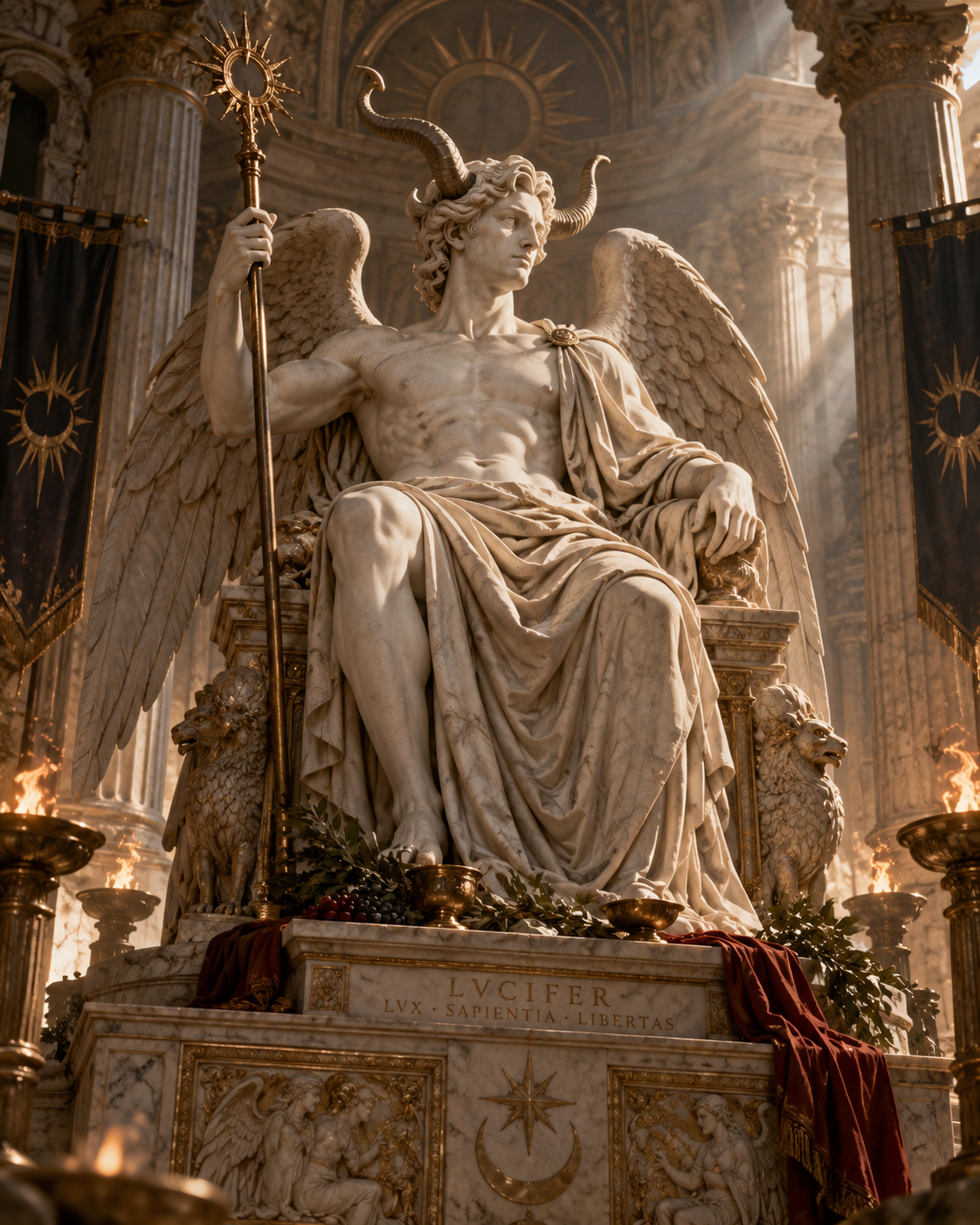
The deepest conflict between The Satanic Self and Christianity concerns the nature of our existence. Are we expressions of divine Being, capable of awakening to ourselves? Or are we creatures standing before a separate God, dependent upon his judgment and permission?
Everything follows from that distinction: the meaning of knowledge, the place of desire, the sacredness of nature, and the purpose of spiritual life.
Hermetic thought gives us a language for divine participation. Mind, cosmos, and humanity belong to a living reality in which self-knowledge can become recognition of our divine origin. The Satanic Self takes this as its starting point: the Self is divine reality becoming conscious through an individual life.
Classical Christianity draws a categorical boundary between Creator and creature. However intimately God sustains the world, creation is not God. However closely a human approaches the divine, the creature does not become the Creator. Even participation in divine life preserves that boundary.
For The Satanic Self, that boundary is precisely what must be challenged.
The divine does not stand outside existence. Nature is its expression. Body, consciousness, hunger, sexuality, imagination, birth, and death occur within Being. There is nowhere else for them to occur. The sacred moves through the world we inhabit and the lives we embody.
Once divinity is placed categorically beyond us, however, spiritual life can become a relationship of dependence. We seek reconciliation with an authority whose commands define our condition. Our deepest question shifts from what we are to what we are permitted to become.
The story of Eden demonstrates that conflict.
The serpent promises enlightenment. Humanity takes the fruit (sexuality). Their eyes open, and God acknowledges that the human has become “like one of us”. The consequence is expulsion, followed by the guarding of the tree of life.
The serpent in Genesis as long been understood to be Satan. The Satanic Self asks: what authority makes divine knowledge a trespass?
The Christian interpretation centers on disobedience. Our reading centers on the threshold itself. Why should humanity’s approach toward divine knowledge require permission? Why should the desire to awaken be treated as corruption?
Here the serpent becomes an initiator. Lucifer becomes the light of consciousness that refuses to remain beneath its prescribed station. Rebellion acquires a spiritual meaning: the refusal to accept estrangement from our own divine depth.
This also changes how we understand desire. Hunger, eros, ambition, and the will to create are the substance of living existence.
Odin offers another image of this awakening. Hanging upon the tree, wounded and given to himself, he gains the runes through ordeal. The sacrifice is Self to Self: consciousness entering its own depths and returning with knowledge. It's worth noting briefly, Odin is the Norse version of Mercury, who is Hermes. The connection to Hermetic writing is not a mistake, but helps show a deep, primordial and perennial tradition in paganism.
Self speaking to Self.
That is the spiritual movement of The Satanic Self. We encounter ourselves through nature, through desire, through suffering, through thought, and through the work of becoming conscious. Knowledge brings responsibility because the life before us is ours to inhabit and shape.
We reject the demand that we understand ourselves first as fallen creatures awaiting restoration by an external sovereign. We begin within the divine reality from which we have never been absent.
The fruit is still before us.
The divine was never elsewhere.